
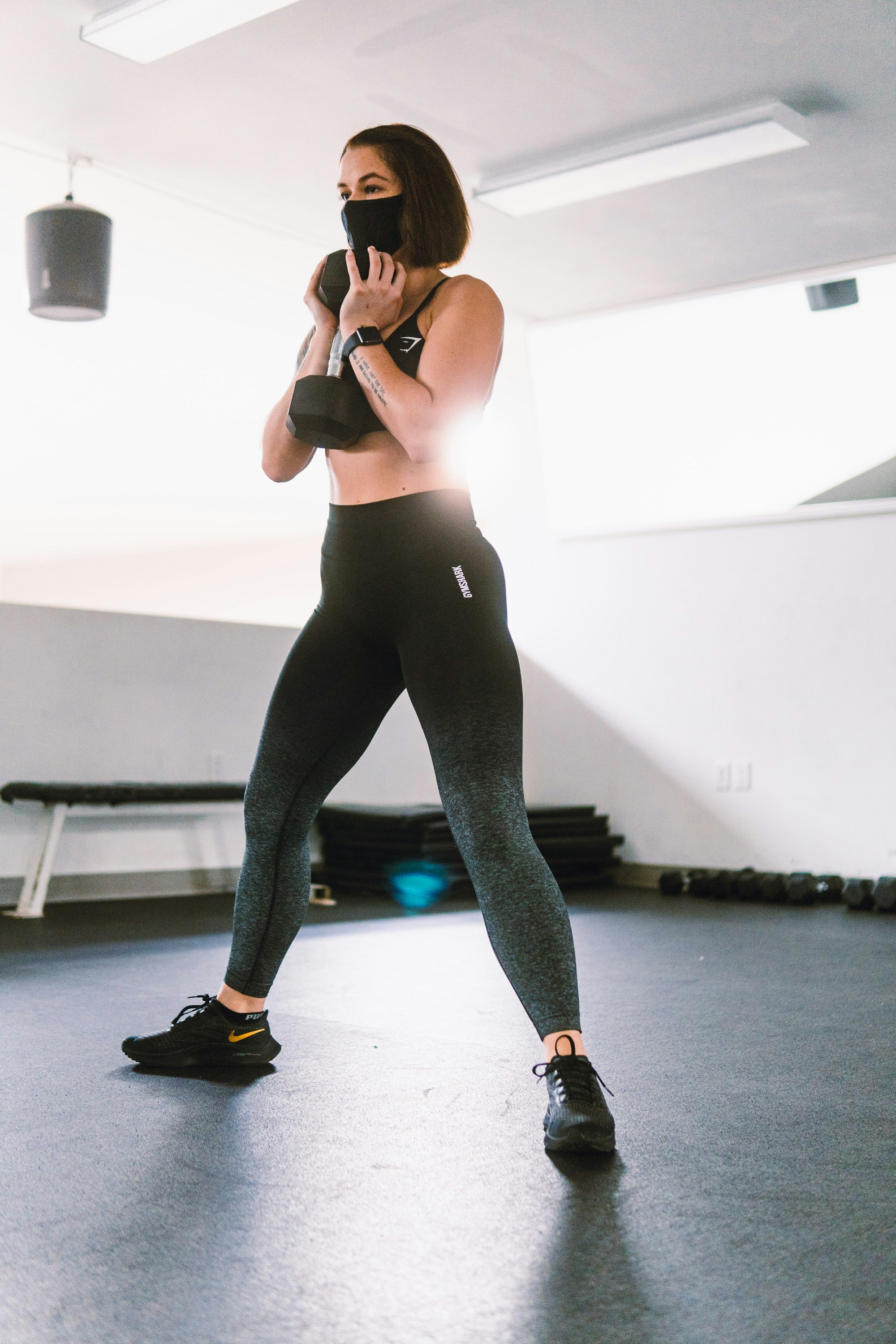

Here’s a glute workout you can do at home with one or two dumbbells: glute bridges, couch hip thrusts, goblet squats, split squats, Romanian deadlifts and step-ups. Do three sets of each, twice a week, and it’ll take you about 30 minutes. It builds your glutes. What it won’t do on its own is melt the fat sitting on top of them. That part comes from a calorie deficit and a lot of walking, and I’ll show you how the two fit into one week.
Ernest here. I’m not a trainer, a dietitian or a doctor. I read the studies and the published guidance before the hype, and I do my workouts in my living room like most of you. If a move hurts your knees, hips or back (sharp pain, not burn), stop and talk to your doctor before you push through it.
The Boring Answer First: You Can’t Burn Fat Off Just Your Butt

I wish I could sell you “the butt fat burner.” I can’t, because the research keeps saying the same thing.
In a 2013 study, Ramírez-Campillo and his team had 11 people train just one leg on a leg press for 12 weeks, three sessions a week, with 960 to 1,200 light reps a session. That’s a ridiculous amount of work for one leg. They did lose some fat. But it came off their arms and trunk, about 10% and 7%, and not from the leg that did all the work.
An older study by Vispute and colleagues tried the same idea on bellies. Twenty-four sedentary adults did seven ab exercises, five days a week, for six weeks. Their ab endurance got better. Their belly fat didn’t change in any meaningful way.
So why train glutes at all? Because muscle is what gives the shape once the fat comes down, and strong hips make every walk, stair and squat in your life easier. Just don’t expect the scale to care which body part you trained. I made the same point about belly workouts in 16 Stomach Exercises for Weight Loss.
Moves 1 and 2: Glute Bridge and Couch Hip Thrust

Glute bridge. Lie on your back, knees bent, feet flat and about hip-width apart. Push through your heels and lift your hips until your body makes a straight line from knees to shoulders. Squeeze for a second at the top, then lower slowly. Start with 3 sets of 15 using just your body weight.
Couch hip thrust. Same movement, bigger range. Sit on the floor with your upper back against the edge of a couch that won’t slide, a dumbbell resting across your hips. Drive your hips up until your thighs are level with the floor, then lower. Go for 3 sets of 10 to 12. Hold the dumbbell with both hands so it doesn’t roll.
Why the hip thrust? In 2015, Bret Contreras and colleagues wired up 13 trained women and compared the barbell hip thrust with the back squat at the same 10-rep effort. The hip thrust lit up the upper glute at 69.5% of max versus 29.4% for the squat, and the lower glute at 86.8% versus 45.4%. That’s muscle activity on a sensor, not muscle growth, and I’ll come back to that. But it’s why the thrust is in here.
Moves 3 and 4: Goblet Squat and Split Squat

Goblet squat. Hold one dumbbell upright against your chest with both hands. Feet a bit wider than your hips, toes turned out a little. Sit down between your heels as low as you can with your chest up, then stand. 3 sets of 10 to 12.
Split squat. Stand a long step in front of your couch and rest the top of your back foot on the cushion. Lower your back knee toward the floor, keeping most of your weight on the front leg, then push back up. This is the one that’ll make you hate me. 3 sets of 8 to 10 on each leg, holding the wall at first if your balance is shaky.
Now the twist I promised. In 2023 some of the same researchers ran a training study on 34 beginners, one group doing hip thrusts and one doing squats. After 9 weeks, glute growth came out about the same in both groups. So the squat isn’t a “quad move” you can skip. Honestly, that’s why this workout has both.
Moves 5 and 6: Romanian Deadlift and Step-Up

Romanian deadlift. Stand tall with a dumbbell in each hand in front of your thighs. Soften your knees, then push your hips back like you’re closing a car door with your butt, sliding the weights down your legs. Keep your back flat. Stop when you feel a strong stretch in your hamstrings, usually around mid-shin, then drive your hips forward to stand. 3 sets of 10.
Step-up. Find a sturdy step, a low bench or the bottom stair. Plant one whole foot on it and push through that heel to stand up on it, without bouncing off the back foot. Step down with control. 3 sets of 10 on each leg. Hold dumbbells once bodyweight gets easy.
If you only have one pair of dumbbells, that’s fine. Bridges are bodyweight, and everything else works with one or two weights you can hold for 10 good reps.
The Whole Session on One Card
Do the moves in that order. Rest 60 to 90 seconds between sets so you’re breathing, not gasping. With a 5-minute warm-up of marching in place and some bodyweight bridges, the whole thing lands near 30 minutes.
Pick a weight where the last two reps of each set are hard but your form still looks like the first rep. If you’ve never done this before, start with bodyweight for the first week. Your glutes will be sore enough to let you know it worked.
What It Burns, and Why the Walks Matter More

Time for the math nobody puts on a Pin. Harvard Health’s table says a 155-pound person burns about 108 calories in 30 minutes of general weight lifting, and about 216 if the lifting is vigorous. Thirty minutes of brisk walking at 3.5 mph burns about 133 calories for the same person, and about 175 at 4 mph.
Read that again. A brisk walk burns more than a normal lifting session, and you can do it five days a week without wrecking your legs for the next workout. Lifting earns its place by building and keeping muscle while you eat less. The walks and the calorie deficit are what move the scale.
That lines up with the CDC’s adult guidelines: at least 150 minutes a week of moderate activity like brisk walking, plus muscle-strengthening on 2 or more days a week that works all the major muscle groups. Two glute sessions cover your legs and hips. Add a couple of upper-body moves when you’re ready, like the ones in my 30-minute full body workout at home.
A Fat-Loss Week That Fits a Tuesday

Here’s how I’d lay it out. Nothing fancy, because fancy is what people quit by week three.
Three 30-minute walks and one 60-minute walk add up to 150 minutes. Two glute sessions on Monday and Thursday give your hips a couple of days to recover between them. Sunday is off. If a Tuesday blows up, move that walk to Sunday and don’t try to “make up” two workouts in one day.
Pair that with a modest calorie deficit and aim for the CDC’s pace: people who lose about 1 to 2 pounds a week are more likely to keep it off than people who lose it faster. No crash diet, no detox, no skipping meals to “help” the workout. If you have a health condition or take medication, run your plan by your doctor first.
When to Add Weight, and When to Stop

When you can do every set of a move at the top of its rep range with good form, make it harder. Add a few pounds, slow down the lowering part to three seconds, or pause at the bottom. That’s how you keep the muscle working when the scale starts dropping, and it’s your best friend when you hit the plateau.
Some things are stop signs, not “push through it” moments. Sharp pain in a knee, your lower back or the front of your hip. Pain that changes how you walk the next day. Numbness or tingling down a leg. Any of those, stop the move and talk to your doctor or a physical therapist before you try it again.
Muscle soreness that peaks a day or two after a new workout is normal. A joint that hurts during the rep is not.
The Boring Answer on Glute Workouts

Six moves, three sets each, twice a week, in your living room. That’ll build your glutes. The fat on top of them comes off the way all fat does, slowly, from a calorie deficit you can keep and walks you actually take. Give it eight weeks before you judge it, take a photo at the start, and don’t let one bad week on the scale talk you out of it.